
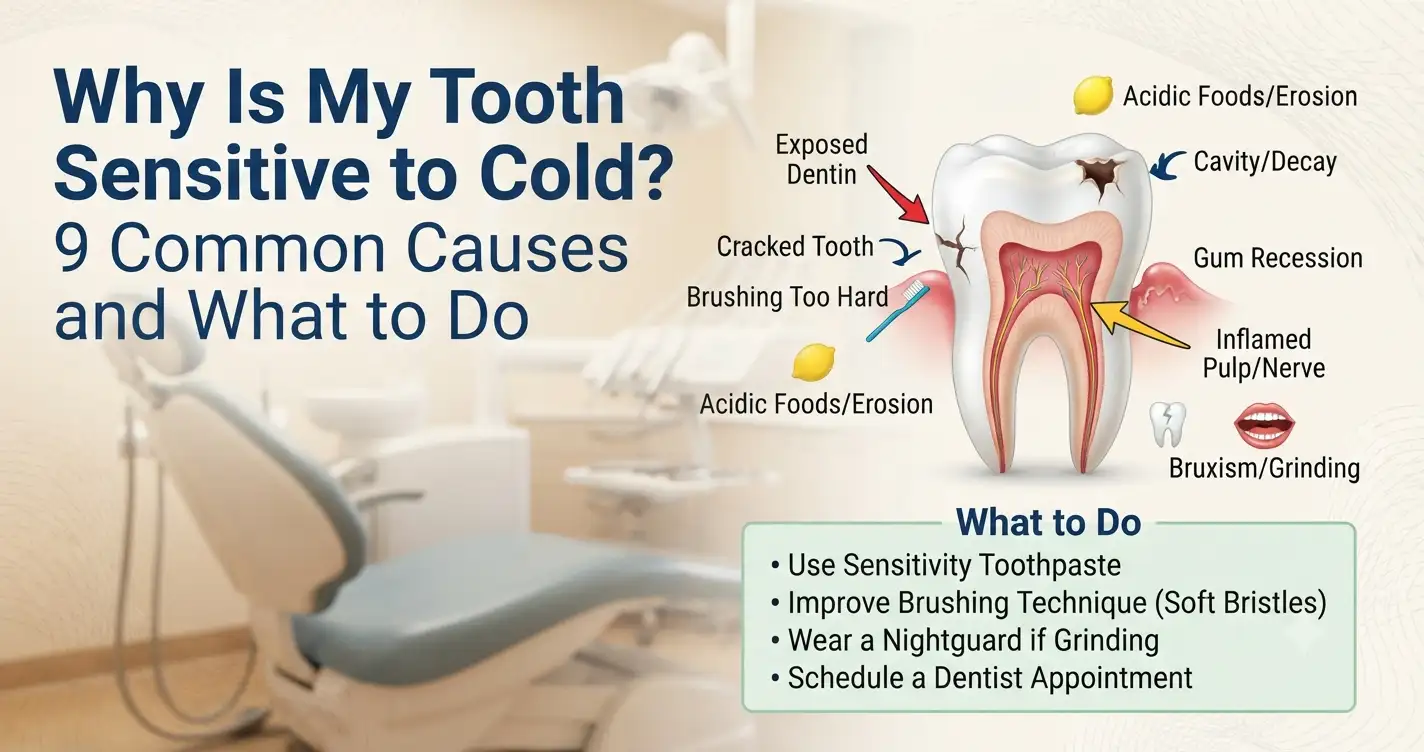
That sharp zing from ice water or ice cream isn’t random. Here are 9 real causes of cold sensitivity and what actually helps.
Why Is My Tooth Sensitive to Cold? 9 Common Causes and What to Do
The first sip of ice water at a restaurant hits one specific tooth like a small electric shock, and for a second the whole conversation stops while you wait for it to pass. It’s over in a few seconds, so it gets ignored, ordered around, mentally filed under “I’ll mention it at my next cleaning” — a next cleaning that’s still four months away.
Cold sensitivity isn’t random and it isn’t automatically a sign of a cavity, even though that’s usually the first assumption. Here’s what’s actually behind it, roughly ordered from most to least common.
The most common reasons a tooth reacts to cold
1. Worn enamel. Enamel is the protective outer layer, and it thins with age, aggressive brushing, or years of acidic food and drink. Once it thins enough, the dentin underneath — which is directly connected to the nerve — gets exposed to temperature changes it wasn’t designed to handle directly.
2. Receding gums. Gum recession exposes the tooth root, which has no enamel covering at all. Root surfaces are far more sensitive to cold than the enamel-covered crown, which is why sensitivity often shows up first near the gumline rather than at the biting surface.
3. A cracked tooth. Cracks can be small enough to miss visually but large enough to let cold liquid reach the nerve through a pathway that shouldn’t exist. This type of sensitivity often comes with a sharp, brief pain specifically on release of biting pressure, not just from cold alone.
4. Tooth decay (a cavity). As decay eats through enamel, it creates a direct path to the nerve. This is the assumption most people jump to first, and it’s a real possibility, but it’s actually one of several — not the automatic default.
5. A recent dental procedure. Fillings, crowns, and whitening treatments can all cause temporary cold sensitivity that resolves within a few days to a few weeks as the tooth settles. Sensitivity that shows up right after a procedure and fades over time is usually not something to worry about.
6. Teeth grinding (bruxism). Grinding wears down enamel from the inside of normal use, often happening overnight without the person realizing it’s happening at all. A partner mentioning grinding sounds at night, or waking up with a sore jaw, is often the first clue before cold sensitivity even shows up.
7. Aggressive brushing technique. A hard-bristled brush combined with heavy pressure wears enamel down over years, particularly right at the gumline where the enamel is already thinner. This is one of the more preventable causes on this list, and one of the most common.
8. Acidic diet. Frequent exposure to soda, citrus, wine, or sports drinks gradually softens and erodes enamel through repeated acid exposure. It’s less about any single drink and more about frequency — sipping something acidic slowly over an hour does more damage than drinking the same amount quickly.
9. Sinus pressure. This one surprises people — sinus infections or congestion can create pressure that radiates into the upper back teeth, mimicking cold sensitivity or general tooth pain that has nothing to do with the tooth itself. If multiple upper teeth are sensitive at once, especially during a cold or allergy flare, sinus pressure is worth considering before assuming a dental problem.
What actually helps, realistically
Switch to a desensitizing toothpaste. Brands built around potassium nitrate or stannous fluoride work by gradually blocking the microscopic tubules in dentin that transmit the cold sensation to the nerve. It typically takes two to four weeks of consistent use to notice a real difference — using it for three days and giving up is the most common reason people think it “doesn’t work.”
Switch to a soft-bristled brush, and actually check the pressure being used. A common trick: hold the brush like a pencil instead of a fist — it naturally reduces pressure without having to consciously think about it every stroke.
Cut back on frequency of acidic drinks, not necessarily total elimination. Drinking through a straw, rinsing with water afterward, and avoiding slow sipping all reduce the cumulative acid exposure time on the enamel.
Get a nightguard if grinding is suspected. A dentist can often tell from wear patterns during a routine exam, even before the patient notices any symptoms themselves. An over-the-counter nightguard is a reasonable low-cost starting point, though a custom-fitted one from a dentist tends to be more comfortable for regular use.
See a dentist if the sensitivity is sharp, localized, or getting worse. General, mild sensitivity across multiple teeth is often manageable with the steps above. Sharp pain in one specific tooth, sensitivity that lingers well after the cold trigger is gone, or pain when biting down are all reasons to get it checked rather than waiting it out — those patterns are more consistent with a cavity or crack than general wear.
A quick note on what this isn’t
Dental researchers, including those cited by the American Dental Association, generally describe sensitivity as a symptom with multiple possible root causes rather than a diagnosis in itself — which is part of why store-bought sensitivity toothpaste doesn’t always fully solve it. If a specific tooth hurts sharply, or the sensitivity has been getting worse over weeks rather than staying steady, that’s a pattern better evaluated by a dentist than guessed at from a symptom list, however detailed.
FAQ
Is tooth sensitivity to cold always a cavity?
No — worn enamel, receding gums, grinding, and even sinus pressure are all common causes that have nothing to do with decay. A cavity is one possibility among several, not the default explanation.
How long does it take for desensitizing toothpaste to work?
Usually two to four weeks of consistent daily use before a noticeable improvement. It works by gradually blocking the pathways that transmit sensation, which takes repeated use rather than a single application.
Should I worry if only one tooth is sensitive?
Sensitivity isolated to a single tooth, especially if it’s sharp or lingers after the cold trigger is removed, is more likely to indicate a cavity, crack, or other localized issue worth having a dentist look at directly.
Can sinus problems really cause tooth sensitivity?
Yes — the upper back teeth sit close to the sinus cavities, and sinus pressure or infection can radiate into those teeth, sometimes mimicking dental pain or cold sensitivity that has nothing to do with the teeth themselves.