
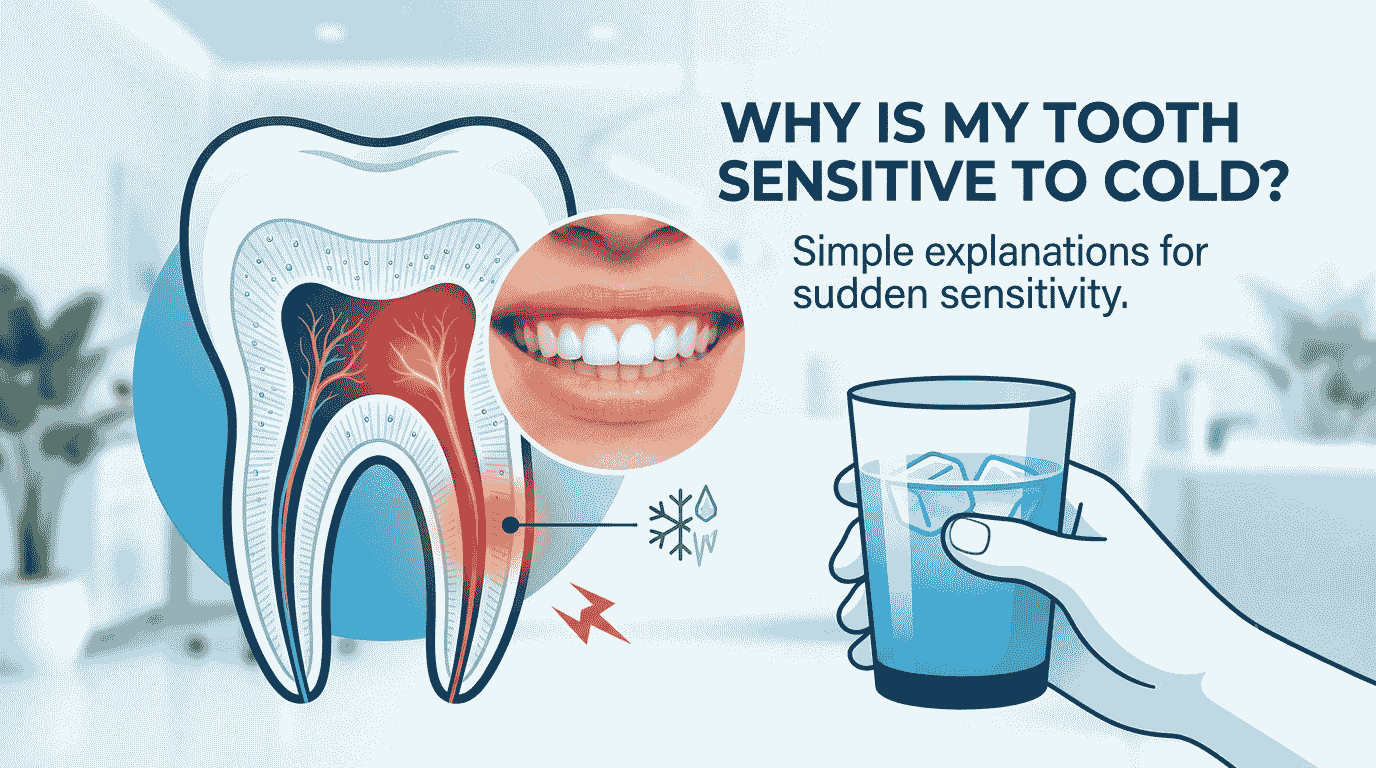
That sharp zing from cold water isn’t random. Here’s why tooth sensitivity to cold happens and what it usually means.
One sip of ice water and there it is — that sudden, sharp jolt that makes you wince mid-sentence. It’s not subtle. It’s not like a dull ache building slowly. It’s immediate, specific, and gone again in a couple of seconds, which is almost more unsettling than if it lingered, because it means something is reacting fast, not just being generally irritated.
That reaction has a real mechanism behind it, and it’s not the same explanation for every case. Cold sensitivity ranges from something as minor as slightly worn enamel to something as serious as a cracked tooth or an infection that needs a root canal. The pattern of the pain — how it starts, how long it lasts, whether it’s one tooth or several — actually tells you a lot before a dentist even looks inside your mouth.
The Actual Mechanism Behind the Pain
Underneath the enamel and a layer called dentin sits a network of microscopic tubules that run straight to the nerve inside the tooth. When enamel is intact and dentin is properly covered, those tubules stay insulated from temperature changes happening in your mouth. Expose that dentin — through worn enamel, a receding gum line, or a crack — and cold liquid or air can travel down those tubules almost instantly, triggering the nerve directly.
That’s the whole explanation for why the pain feels so sudden and specific rather than a dull ambient ache. It’s not really inflammation building up. It’s a fast physical signal reaching a nerve that used to be insulated from it.
Worn Enamel: The Most Common Cause
Enamel erodes gradually, from acidic foods and drinks, from aggressive brushing with a hard-bristled toothbrush, from teeth grinding, from age. None of this happens dramatically. It’s cumulative — years of orange juice at breakfast, years of brushing too hard right after eating something acidic, when enamel is temporarily softened and more vulnerable to being scrubbed away.
This version of sensitivity tends to show up gradually too. Mild at first, only with very cold things, then slowly extending to moderately cool water, then to cold air on a winter walk. If that gradual timeline matches your experience, worn enamel is the most likely explanation, and it’s also the most manageable one.
Receding Gums Expose Root Surfaces Directly
Gums that have receded — from aggressive brushing, from periodontal disease, from age, sometimes just from genetics — expose the root surface of the tooth, which was never covered by hard enamel in the first place. Root surfaces are covered by cementum, a much softer material that wears away easily and doesn’t protect dentin nearly as well as enamel does.
This is usually why sensitivity concentrates specifically at the gumline rather than across the whole tooth, and why it often shows up on just a few teeth rather than everywhere at once — wherever the gum has receded the most.
A Cracked Tooth Feels Different
Cracked tooth pain has a specific signature that’s worth knowing, because it changes what needs to happen next. Instead of a general zing, it’s often a sharp pain specifically on biting down or specifically on release — releasing the bite, not applying it — combined with cold sensitivity that comes and goes unpredictably rather than reliably with every cold exposure.
Cracks don’t always show up on an X-ray, which is part of why cracked tooth pain sometimes gets dismissed or misdiagnosed initially. If pain is inconsistent, sharp on biting, and doesn’t match the steady pattern of enamel wear, that’s worth flagging specifically to a dentist rather than assuming it’s routine sensitivity.
A Recent Dental Procedure Can Cause Temporary Sensitivity
New fillings, crowns, whitening treatments, and deep cleanings can all cause temporary sensitivity that has nothing to do with an underlying problem — it’s the tooth’s nerve reacting to recent disturbance and settling back down. This version usually fades over one to a few weeks on its own.
Sensitivity that starts right after a procedure and is already improving is generally not a concern. Sensitivity that starts weeks later, or keeps getting worse rather than better, is a different situation and worth a follow-up call.
When It’s a Cavity, Not Just Sensitivity
Cavities cause a version of cold sensitivity that tends to linger longer than the fast-in-fast-out pattern of enamel wear — a lingering ache after the cold trigger is gone, sometimes minutes later, rather than a jolt that disappears in a couple of seconds. That lingering quality is one of the more reliable signals that something structural is happening inside the tooth rather than just surface-level exposure.
Untreated, this pattern tends to progress toward pain with heat too, and eventually spontaneous pain with no trigger at all — which usually means the decay has reached the nerve.
Whitening Products Are a Common, Temporary Cause
Whitening treatments, both professional and over-the-counter strips, temporarily open up those dentin tubules as part of how the whitening process works, which is why a lot of people notice sensitivity specifically during a whitening course that fades once it’s finished. Using a desensitizing toothpaste for a week or two before starting whitening, and spacing out sessions rather than doing them back to back, usually reduces this considerably.
What Actually Helps at Home
Desensitizing toothpaste, the kind built around potassium nitrate or stannous fluoride, works by gradually blocking those exposed tubules with repeated use — usually noticeable improvement within two to four weeks of consistent use, not overnight. A soft-bristled toothbrush and a gentler brushing technique prevent further enamel and gum recession, which matters more long-term than any single product.
Avoiding brushing immediately after acidic food or drink — waiting around 30 minutes lets enamel re-harden first — reduces the mechanical wear that acidic softening makes worse. And for grinding-related sensitivity, a night guard addresses the actual cause rather than just managing the symptom that shows up downstream from it.
When to Actually See a Dentist
Sensitivity that’s new, sudden, and severe — rather than a gradual worsening over months — deserves a dental visit rather than a wait-and-see approach, especially if it’s concentrated in one specific tooth rather than spread across several. Same for sensitivity that lingers well after the cold trigger is gone, pain on biting down, or any sensitivity that’s paired with visible damage, a dark spot, or swelling nearby.
Sensitivity that’s mild, gradual, spread across multiple teeth, and matches a known cause — recent whitening, a history of hard brushing — is generally safe to address at home first with a desensitizing toothpaste and a gentler routine, with a dental visit if it hasn’t improved after a few weeks.
FAQ
Why does my tooth hurt with cold water specifically?
Exposed dentin underneath the enamel contains tubules that lead directly to the tooth’s nerve. When enamel is worn or gums have receded, cold liquid reaches those tubules and triggers a fast, sharp nerve response.
Is tooth sensitivity to cold always a sign of a cavity?
No. Worn enamel, receding gums, a recent dental procedure, or whitening treatments are all common causes. A cavity is more likely when the pain lingers well after the cold trigger is gone, rather than fading within a couple of seconds.
Can tooth sensitivity go away on its own?
Sometimes, particularly after a recent dental procedure or a whitening course, where it’s usually temporary. Sensitivity from worn enamel or receding gums typically needs a desensitizing toothpaste or dental treatment rather than resolving on its own.
What toothpaste helps with cold sensitivity?
Toothpaste containing potassium nitrate or stannous fluoride is specifically formulated to reduce sensitivity, usually with noticeable improvement after two to four weeks of consistent use.
When should I see a dentist about tooth sensitivity?
If it’s sudden and severe, concentrated in one tooth, lingers after the cold is gone, occurs with biting pressure, or comes with visible damage or swelling — all of these warrant a dental visit rather than home treatment alone.